Species Spotlight
Species Spotlight: The Green Sea Turtle
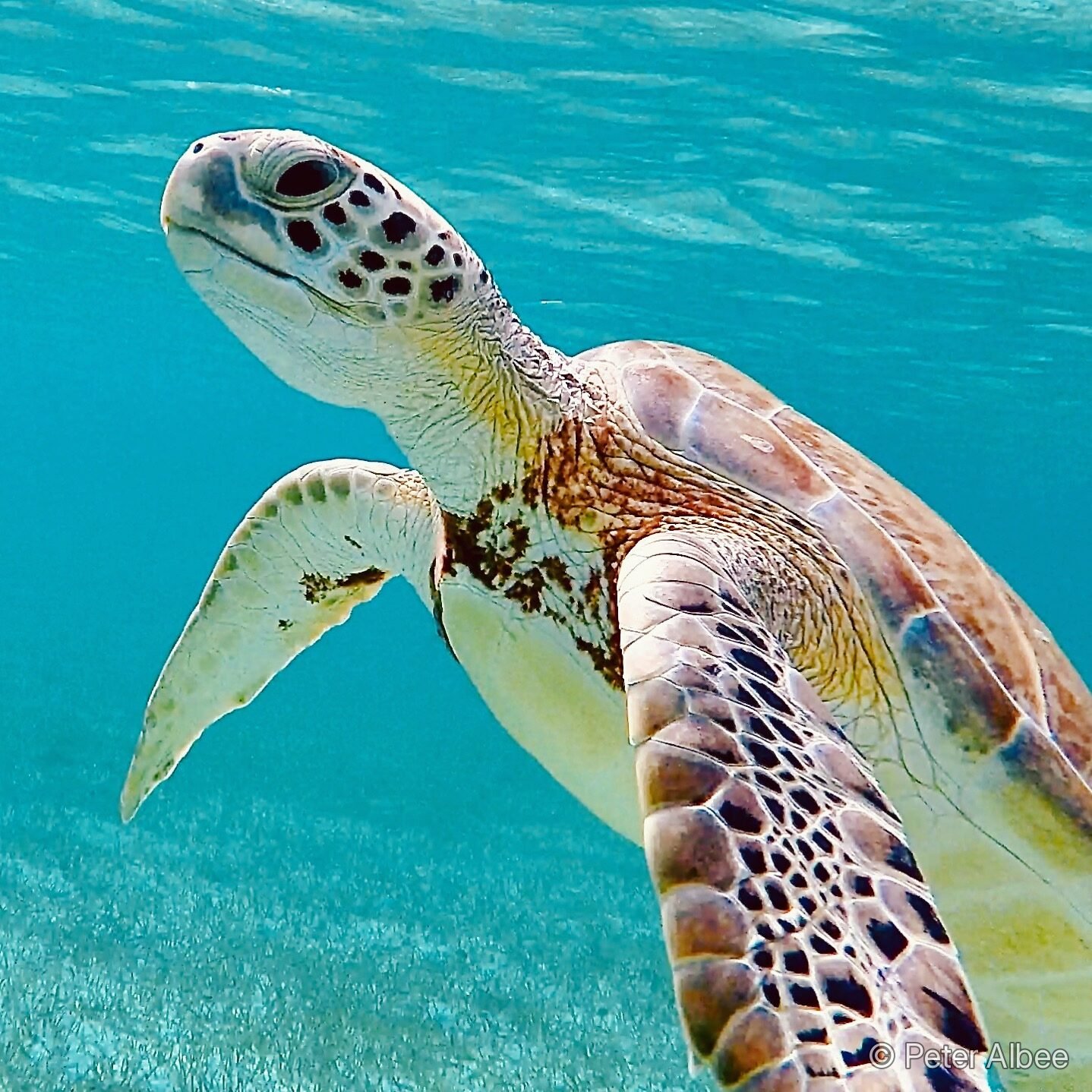
If I had to guess which single species appears most often across my archive of half a million images, it's the green sea turtle. They're common across every region I've worked — South Florida, the Bahamas, Turks & Caicos, Belize, Honduras, and Mexico — and after decades in the water with them, I still stop what I'm doing every time one swims past.
What makes them "green"
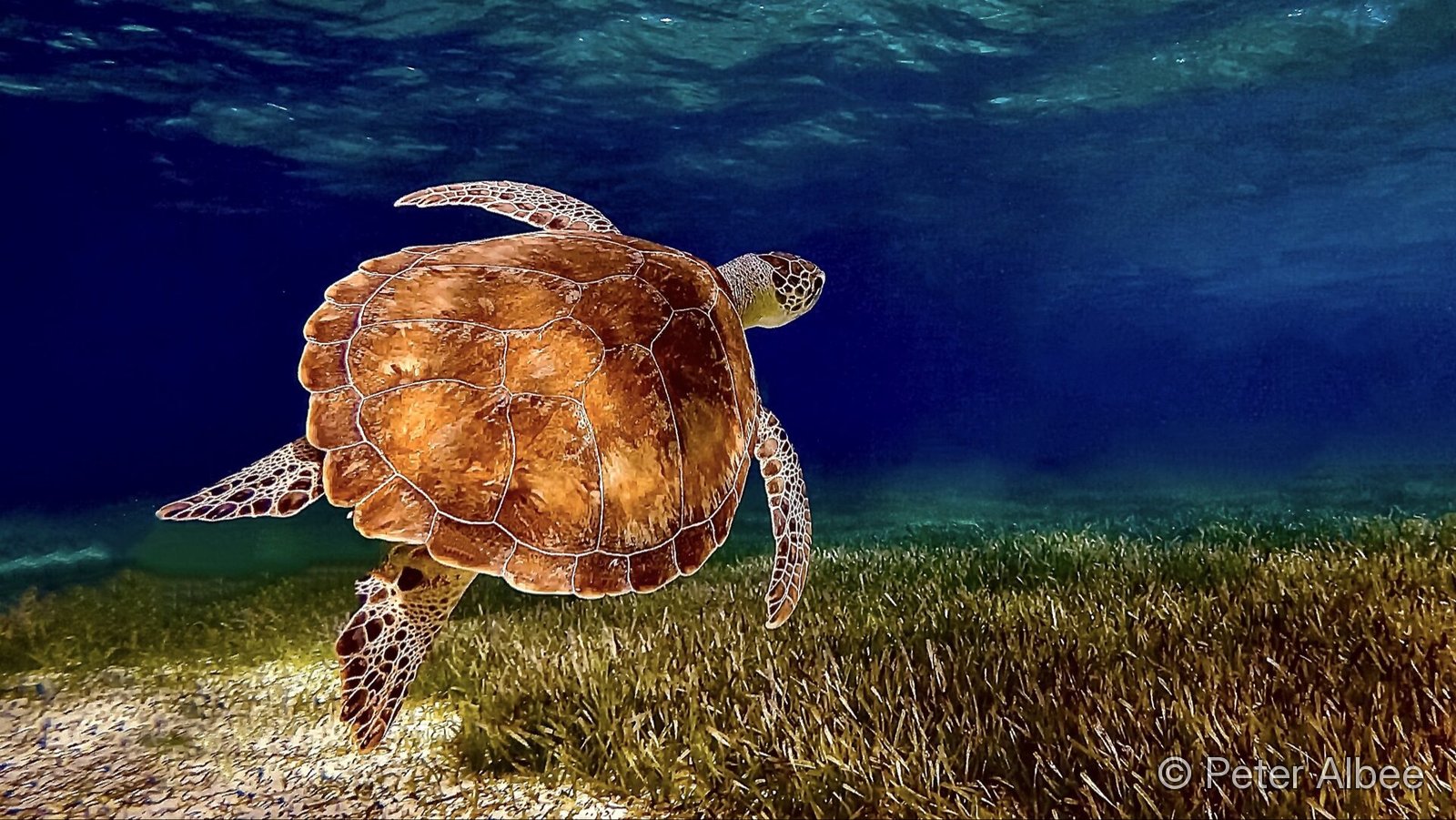
The green sea turtle (Chelonia mydas) isn't named for its shell color, which typically ranges from olive-brown to almost black, but for the greenish tint of its body fat — a byproduct of its largely herbivorous diet of seagrass and algae. They're the only sea turtle species that's primarily vegetarian as adults, which is part of why they're so often found grazing over the seagrass beds that carpet the shallows throughout the Caribbean.
Behavior worth knowing before you shoot
- They need to surface to breathe — but can hold their breath for hours at rest. A turtle that seems to be resting on the bottom may stay put for a long time, giving you a rare, patient subject.
- They graze with their heads down — approach from the side or slightly ahead rather than directly behind, or you'll only ever get shell shots.
- Juveniles are more skittish than adults — a large, well-fed adult in a protected area is often remarkably calm around slow-moving snorkelers.
Every turtle has a personality. Some will let you swim alongside for ten minutes. Others want nothing to do with you the moment you enter the water. You learn to read that in the first five seconds.
Getting the portrait shot
My favorite green sea turtle images are close head-on portraits — the kind where you can see the individual scales on the face and the water catches the edge of the shell. Getting there takes a slow approach, neutral buoyancy, and a willingness to let the turtle set the pace. Chasing never works. Waiting almost always does.
These are also the shots that work best as split-level compositions when a turtle surfaces for air near the boat — which is part of why they show up so often in our gallery's split-level category.
Conservation note: green sea turtles are listed as endangered across much of their range. Responsible photography means no touching, no chasing, and no altering their natural behavior for a shot — a rule I've followed since long before it was standard practice.